What is Integrated Pest Management (IPM)?
Integrated Pest Management (IPM) is an ecologically based approach to achieving long-term management of pest problems with minimal impact on human health and the environment. IPM is not a single pest-control method but rather a series of pest-management evaluations, decisions, and controls. Essential elements of integrated pest management are education, monitoring, pest prevention, use of least hazardous approach to control pests, pesticide use notification, and record keeping.
IPM programs use current, comprehensive information on the life cycles of pests and their interaction with the environment. The IPM approach can be applied to both agricultural and non-agricultural settings, such as the home, garden, and workplace. IPM takes advantage of all appropriate pest management options.
The concept and impetus for IPM grew out of the discontent with using a purely insecticidal approach to insect control in many areas in the 1950′s. Overuse of insecticides resulted in insects that were resistant to insecticides, resurgence of pests after treatment and occurrence of secondary pests that became a problem only after the natural enemies that had been keeping them in check were killed by insecticides. “Integrated control” was developed emphasizing use of selective insecticides so that natural enemies were conserved in the system. This “integration” of control techniques was expanded in later years to include other management options such as resistant crop varieties, crop rotation and other tactics and to include weed and diseases as pests in addition to insects.
What began 30 years ago as a lofty notion to partner with nature when controlling pest problems has blossomed into a nationally accepted practice that saves the environment, money, and reduces pesticide use. This innovative approach, termed Integrated Pest Management or IPM, applies a holistic solution to the problem of managing harmful insects, weeds, and plant diseases.
Integrated Pest Management (IPM) is based on scientific research and focuses on long-term prevention of pests or their damage by managing the ecosystem. The most effective, long-term way to manage pests is by using a combination of methods that work better together than separately. Approaches for managing pests are often grouped in the following categories: Biological Control, Cultural Control, Mechanical/Physical Control, and Chemical Control.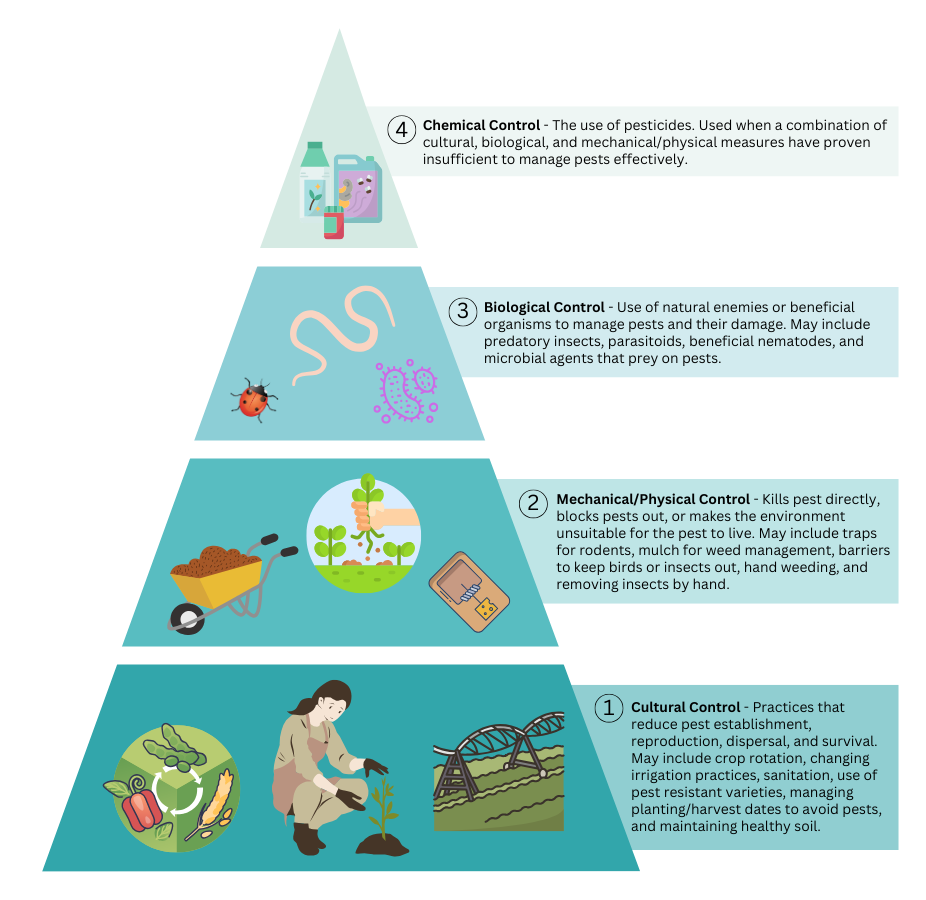
IPM in Schools
- EPA website - Links to the EPA's School IPM Directory, which lists state contacts for specific information.
- University of Florida Website - Maintained by the University of Florida - Supported by the EPA and the National IPM network. The site gives the latest IPM news and technical information. In addition, you can order the National School IPM CD ROM.
- Technical Resource Center for IPM - Maintained by Texas A&M University, this site is similar to Purdue's and rounds up IPM information for Texas, New Mexico, and Oklahoma.
- IPM Institute of North America, Inc. - This non-profit organization offers IPM.